Our Data Integrity Expertise
Our approach identifies risks affecting the reliability, traceability and availability of data, then defines measures proportionate to the stakes for the product, the patient and regulatory compliance.
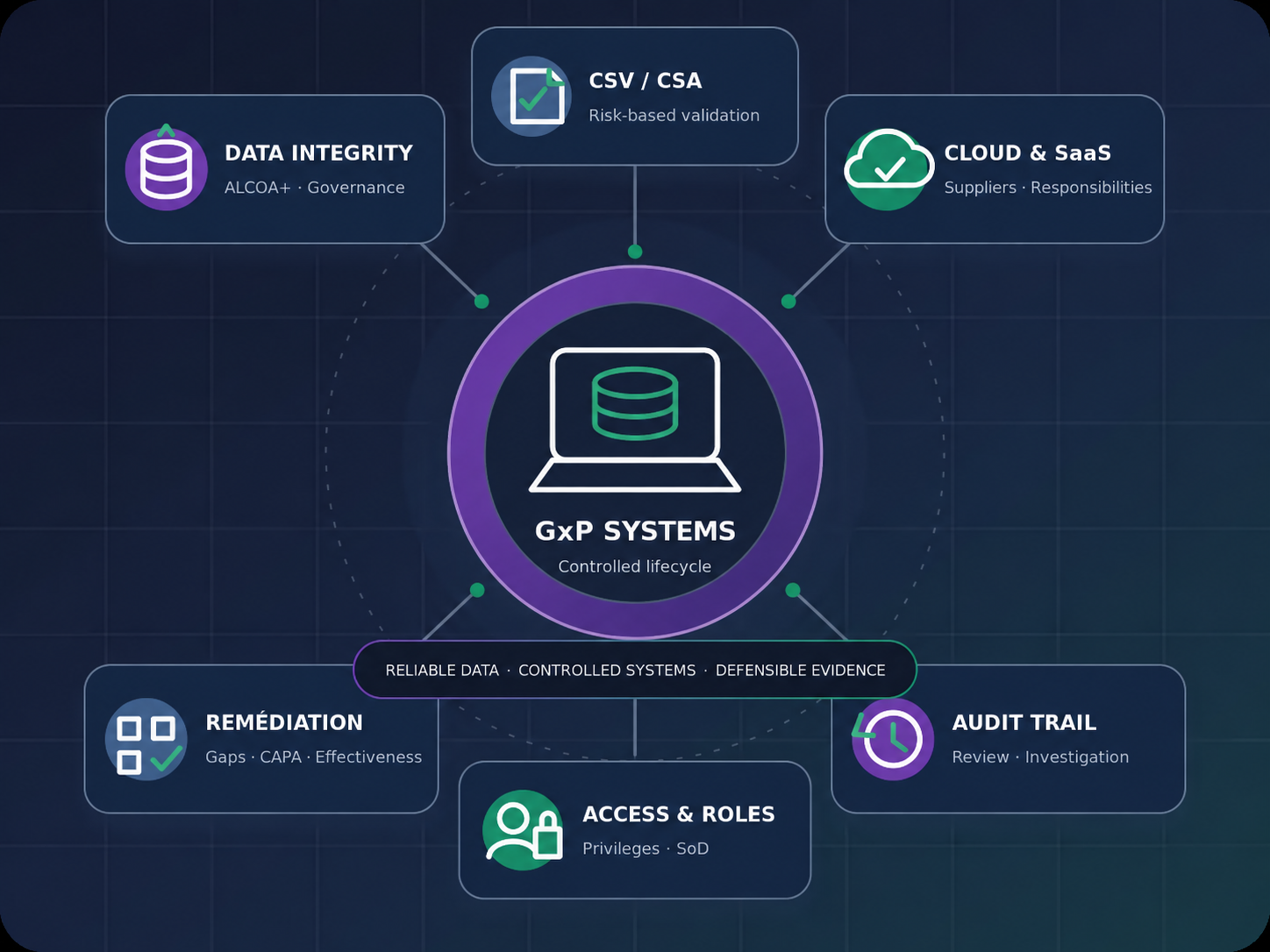
Data Integrity deviations can compromise the compliance of your data, product quality and the trust of authorities. Identify the warning signs so you can act before the inspection.
The goal is not simply to show that ALCOA+ principles are mentioned in your procedures. You must be able to demonstrate that they are actually applied in your systems, processes and day-to-day practices.
Shared or non-nominative access to systems.
Audit trails not regularly examined.
Missing or untraceable source data.
Critical files with no version control or review.
Backups that are untested or undocumented.
Poorly defined roles and responsibilities.
A complete offering to assess, structure and secure your GxP data.
Assess your organisation's maturity and identify the main gaps against applicable regulatory expectations.
The assessment can cover a site, a process, a function, a computerized system or the entire Data Integrity programme.
Diagnostic report, maturity map, gap register and prioritised recommendations.
Identify situations where data could be created, modified, deleted, transferred or interpreted without sufficient control.
The audit examines how ALCOA+ principles are actually applied to paper, electronic and hybrid data.
ALCOA+ assessment grid, audit report, risk analysis and action plan.
Identify critical data, its vulnerabilities and the controls needed throughout its entire lifecycle.
The analysis helps focus effort on the data and steps presenting the most significant risks.
Data Integrity risk analysis, critical data map and risk reduction plan.
Define a clear organisation to assign responsibilities and maintain control over data over time.
Policy, master plan, responsibility matrix, procedures and monitoring indicators.
Define an audit trail review strategy based on data criticality, process risk and system functionality.
Audit trail review strategy, criticality matrix, procedure, review guide and report template.
Turn findings from an audit, inspection or internal assessment into a structured improvement programme.
Remediation plan, CAPA, revised procedures, compensating controls and effectiveness report.
A comprehensive approach to guarantee the integrity of your data, from creation to archiving.
Collect reliable, attributable data.
Transform and use controlled data.
Verify and approve data and records.
Ensure data security and availability.
Retain data according to regulatory requirements.
We work across all regulated domains and critical systems.
Medicinal products (manufacturing)
Clinical trials
Pharmacovigilance
Distribution
Devices and IVDs
A structured, pragmatic approach, tailored to your context.
Understand your context, challenges and objectives.
Analyse what exists (documents, systems, practices).
Identify gaps and analyse risks.
Define a realistic, targeted action plan.
Implement actions with your teams.
Measure progress and sustain compliance.
Answers to the most common questions about our Data Integrity expertise.
A Data Integrity Assessment is a structured evaluation of the organisation, processes, systems and controls used to ensure the reliability of GxP data. It identifies gaps, assesses risks and defines the actions needed to strengthen data control.
Data security mainly aims to protect information against unauthorised access, modification, loss or disclosure. Data Integrity covers a broader scope: data must also be attributable, legible, contemporaneous, original, accurate, complete, consistent, enduring and available.
Preparation should cover procedures, responsibilities, operational practices, system configurations, access, audit trails, backups and evidence of review. A documentation review alone is not enough if actual practices don't match the described processes.
The need, scope and frequency of review should be defined based on risk, data criticality, the relevant process and system functionality. The goal is to identify events likely to affect the reliability or interpretation of critical data.
No. The level of control depends on intended use, file complexity, data criticality, functions used and existing controls. A file used to perform calculations or support a GxP decision may require assessment and appropriate validation measures.
Duration depends on scope: a single system, a process, a department, a site or a full programme. Initial scoping determines the number of interviews, documents to review, field observations and expected depth.
An initial conversation helps us understand your context, identify the main risks and define the right scope of engagement.
Request a Data Integrity diagnostic